
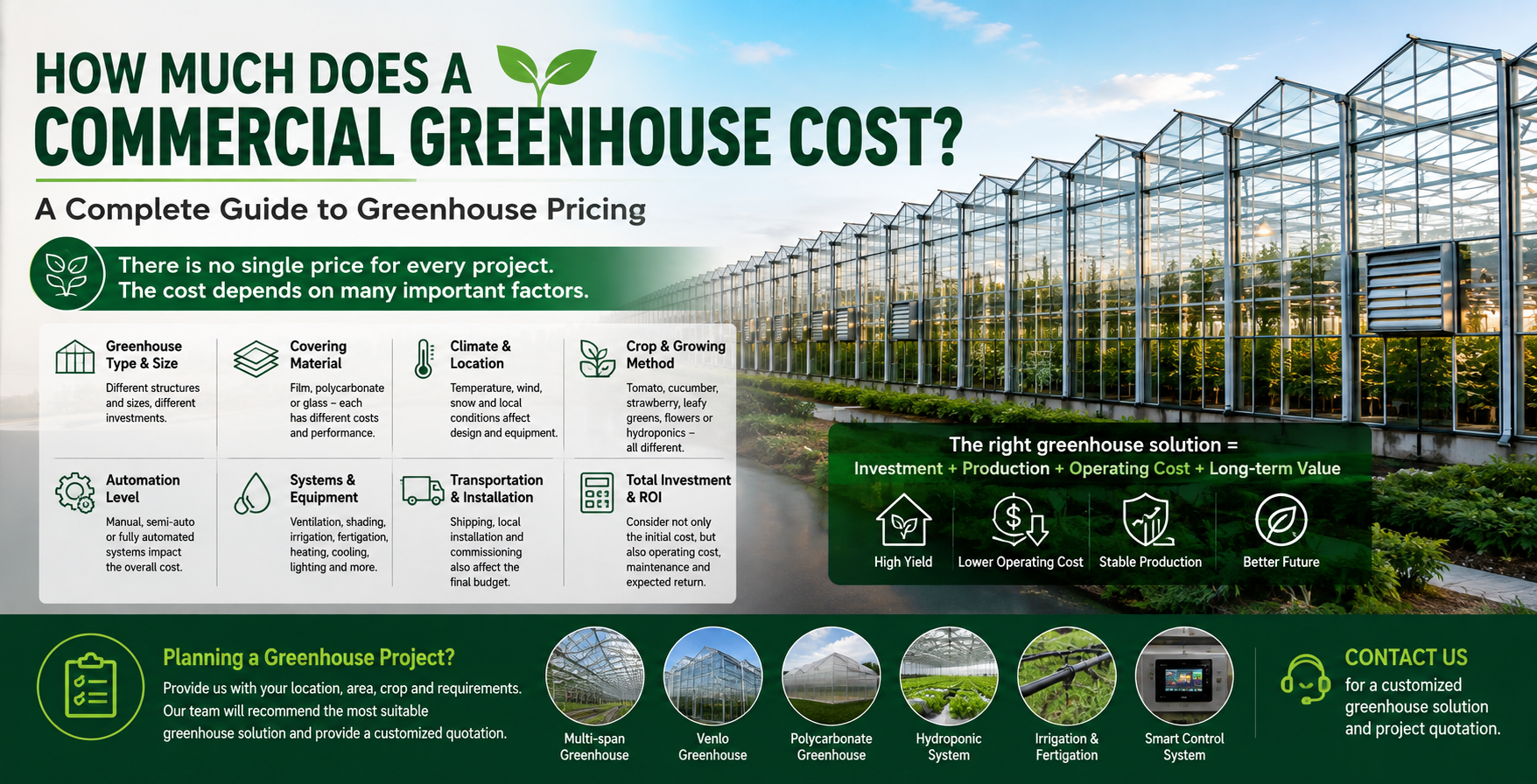
How Much Does a Commercial Greenhouse Cost? A Complete Guide to Greenhouse Pricing

Commercial greenhouse projects are a significant investment, and one of the first questions growers, investors, and agricultural businesses ask is: How much does a commercial greenhouse cost?
The answer is not simply a price per square meter. Greenhouse costs depend on the greenhouse structure, covering materials, climate, crop, equipment, automation level, installation requirements, and local conditions.
This guide explains the main factors that determine commercial greenhouse costs and provides a practical framework for estimating your project budget.
1. What Is Included in the Cost of a Commercial Greenhouse?
A complete commercial greenhouse project may include much more than the greenhouse structure itself.
Typical cost components include:
- Greenhouse steel structure
- Covering materials
- Ventilation systems
- Shading systems
- Heating and cooling systems
- Irrigation and fertigation systems
- Environmental control systems
- Lighting systems
- Growing systems
- Hydroponic systems
- Nursery benches or mobile benches
- Internal transportation systems
- Electrical systems
- Water supply and drainage
- Installation and commissioning
- Transportation and customs costs
Therefore, two greenhouses with the same floor area can have significantly different total project costs.
2. Main Factors Affecting Commercial Greenhouse Cost
Greenhouse Type
Different greenhouse structures have different construction and equipment requirements.
Common commercial greenhouse types include:
- Multi-span greenhouses
- Venlo greenhouses
- Polycarbonate greenhouses
- Glass greenhouses
- Tunnel greenhouses
- Plastic film greenhouses
- Nursery greenhouses
- Hydroponic greenhouses
For example, a basic plastic-film greenhouse generally requires less investment than a highly automated glass greenhouse equipped with climate control and advanced growing systems.
Greenhouse Size
Project size has a major impact on the overall investment.
A larger greenhouse project may benefit from economies of scale because structural materials, equipment, transportation, and installation can sometimes be optimized across a larger area.
However, the total project budget should be calculated based on the complete system configuration, rather than simply multiplying area by a basic greenhouse price.
Covering Material
The covering material is another important cost factor.
Common options include:
PE film
Suitable for many commercial agricultural applications and generally provides a cost-effective solution.
Polycarbonate panels
Offer good insulation and durability and are widely used where higher thermal performance is required.
Glass
Often selected for high-end commercial greenhouse projects where maximum light transmission, durability, and long-term performance are priorities.
The appropriate covering material depends on the local climate, crop requirements, expected service life, and investment budget.
3. Climate and Location Matter
A greenhouse designed for a mild climate can have very different equipment requirements from one designed for a cold, hot, windy, or snowy region.
For example, projects in colder climates may require:
- Heating systems
- Thermal screens
- Higher-performance coverings
- Better insulation
- More sophisticated climate control
Projects in hot climates may require:
- Roof ventilation
- Side ventilation
- Shade systems
- Cooling pads
- Exhaust fans
- Fogging systems
Wind and snow loads can also affect the structural design and steel consumption.
For this reason, a professional greenhouse quotation should be based on the project location and local climate conditions, rather than a standard price alone.
4. Crop Type Influences the Investment
The crop being grown is another important factor.
Tomatoes, cucumbers, strawberries, lettuce, herbs, flowers, and nursery plants have different requirements for temperature, humidity, irrigation, lighting, support systems, and growing methods.
For example, a commercial tomato greenhouse may require:
- Crop support systems
- Drip irrigation
- Fertigation
- Climate control
- Insect screens
- Trellising systems
A commercial lettuce greenhouse using hydroponics may require:
- NFT or other hydroponic systems
- Growing channels
- Nutrient tanks
- Pumps
- Water filtration
- pH and EC monitoring
- Automated nutrient management
Therefore, crop + growing method + production target should be considered when estimating the total project cost.
5. Automation Level
Automation can significantly change the investment level.
A basic greenhouse may use manually operated ventilation and irrigation.
A more advanced commercial greenhouse can integrate:
- Automatic ventilation
- Automatic shading
- Climate sensors
- Temperature and humidity control
- CO₂ management
- Automatic irrigation
- Fertigation
- Weather stations
- Remote monitoring
- Centralized greenhouse control systems
Automation generally increases the initial investment, but it can also improve production efficiency, reduce labor requirements, and provide more precise growing conditions.
The right question is therefore not simply:
“How can I get the cheapest greenhouse?”
A better question is:
“What greenhouse configuration provides the best balance between investment, production, operating cost, and expected return?”
6. Installation and Transportation Costs
For international greenhouse projects, the quotation may also need to consider:
- Ocean freight
- Inland transportation
- Port charges
- Import duties
- Local installation
- Equipment commissioning
- Local labor
- Construction materials
These costs can vary significantly depending on the destination country and project location.
For overseas customers, it is important to clarify whether a supplier’s quotation is:
- EXW
- FOB
- CIF
- DAP
- DDP
A low factory price does not necessarily mean a low final project cost.
7. How to Estimate a Commercial Greenhouse Budget
A practical approach is to divide the project into several categories:
Greenhouse structure + covering
↓
Climate control
↓
Irrigation and fertigation
↓
Growing system
↓
Automation
↓
Installation
↓
Transportation and related project costs
This provides a more realistic picture of the total investment than comparing greenhouse prices based only on the steel structure.
For example, when requesting quotations from different suppliers, buyers should provide:
- Project location
- Total greenhouse area
- Greenhouse dimensions
- Crop
- Growing method
- Expected production
- Local climate conditions
- Required automation level
- Heating/cooling requirements
- Irrigation requirements
- Installation requirements
The more detailed the project information, the more accurate the quotation can be.
8. How to Reduce Greenhouse Investment Without Sacrificing Quality
Reducing the initial investment does not necessarily mean choosing the cheapest greenhouse.
Instead, consider the following strategies:
Choose the Right Greenhouse Type
Not every crop requires a high-end glass greenhouse. Selecting the appropriate structure for the crop and climate can significantly reduce unnecessary investment.
Prioritize Essential Equipment
Start with the systems that directly affect crop production and climate management.
Additional automation can be introduced later if the project design allows future expansion.
Optimize the Greenhouse Layout
A well-designed greenhouse layout can reduce unnecessary material consumption and improve the efficiency of irrigation, ventilation, transportation, and installation.
Consider Long-Term Operating Costs
A cheaper greenhouse may have higher energy, maintenance, and labor costs.
The better comparison is:
Initial Investment + Operating Cost + Maintenance Cost + Expected Production
rather than simply comparing the purchase price.
9. What Information Do Suppliers Need to Provide an Accurate Quote?
Before requesting a commercial greenhouse quotation, prepare the following information:
Project location:
Country, city, altitude, wind conditions, and snow conditions if applicable.
Greenhouse area:
For example, 1,000 m², 5,000 m², 10,000 m², or larger.
Crop:
Tomato, cucumber, strawberry, lettuce, flowers, nursery plants, etc.
Growing method:
Soil cultivation, substrate cultivation, NFT, DWC, Dutch bucket, or other hydroponic systems.
Climate requirements:
Heating, cooling, ventilation, shading, humidity control, and other requirements.
Automation requirements:
Manual, semi-automatic, or fully automated.
Installation:
Supply only or complete installation and commissioning.
With this information, a greenhouse manufacturer can develop a much more accurate technical proposal and quotation.
10. Commercial Greenhouse Cost: The Bottom Line
There is no single price that applies to every commercial greenhouse project.
The final cost depends on:
Greenhouse type + size + climate + crop + covering + equipment + automation + installation + logistics
A small basic greenhouse and a fully automated commercial greenhouse may have completely different investment levels, even if their floor areas are similar.
For growers planning a new greenhouse project, the best approach is to first define the production goals and local growing conditions, then select the greenhouse structure and equipment configuration accordingly.
Looking for a Commercial Greenhouse Solution?
If you are planning a commercial greenhouse project, provide us with your project location, greenhouse area, crop, growing method, and main requirements.
Our technical team can evaluate your project and recommend a suitable greenhouse structure, climate-control system, irrigation solution, and growing system based on your production goals and budget.
Contact us for a customized greenhouse solution and project quotation.