
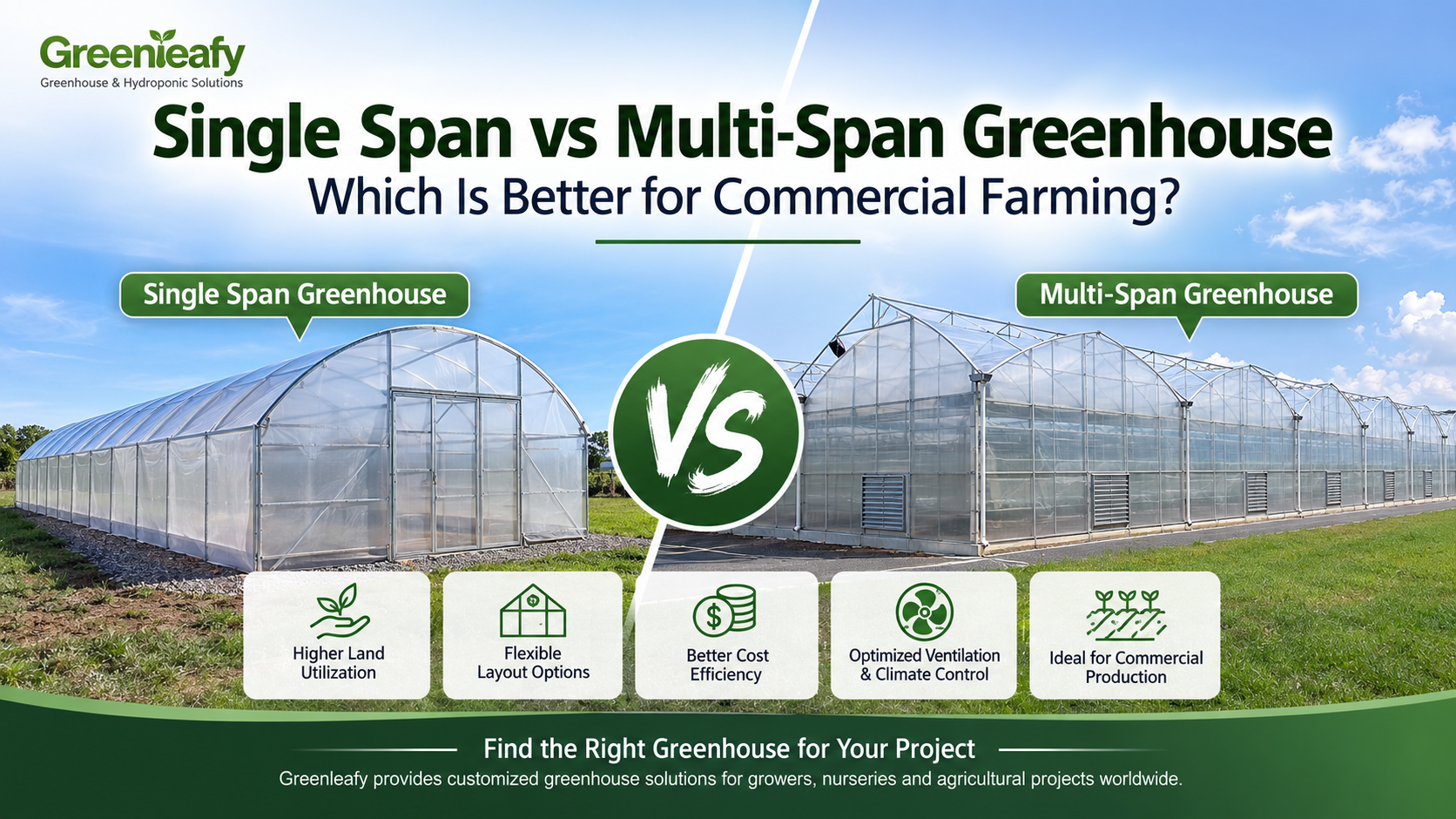
Single Span vs Multi-Span Greenhouse: Which Is Better for Commercial Farming?

Choosing the right greenhouse structure is one of the most important decisions when planning a commercial growing project.
Two of the most common options are single span greenhouses and multi-span greenhouses.
Although both can provide a controlled environment for crop production, they are designed for different scales, site conditions, budgets and production goals.
So, which one is better?
There is no single answer.
A single span greenhouse can be an excellent choice for small and medium-sized farms, nurseries and projects that require independent growing units. A multi-span greenhouse is usually more suitable for larger commercial operations that need a continuous growing area, higher space utilization and easier integration of climate-control systems.
In this guide, we compare single span and multi-span greenhouses in terms of structure, cost, available growing area, ventilation, installation, expansion and commercial applications.
What Is a Single Span Greenhouse?
A single span greenhouse is an independent greenhouse structure consisting of one continuous span between its side walls.
It can be designed in different widths, lengths and heights depending on the crop, climate and project requirements.
Single span greenhouses are commonly used for:
- Vegetable production
- Flower cultivation
- Nursery production
- Seedling propagation
- Small and medium-sized commercial farms
- Research and demonstration projects
- Specialized crop production
One of the main advantages of a single span greenhouse is its flexibility.
Different greenhouse units can be used for different crops or growing conditions. For example, a farm could use one greenhouse for seedlings and another for mature vegetable production.
This can also make crop management easier when different production areas require different environmental conditions.
What Is a Multi-Span Greenhouse?
A multi-span greenhouse consists of several greenhouse spans connected together to create one larger continuous growing area.
Instead of having multiple independent greenhouse structures, several spans share side walls and internal structural components.
Multi-span greenhouses are widely used for:
- Large-scale vegetable production
- Commercial flower production
- Nursery production
- Hydroponic farming
- Large agricultural projects
- Research facilities
- High-efficiency commercial growing operations
The continuous structure allows growers to make better use of the available land and integrate equipment such as:
- Ventilation systems
- Cooling systems
- Irrigation systems
- Heating systems
- Shade systems
- Rolling benches
- Hydroponic systems
- Environmental control equipment
For large commercial projects, this integrated layout can make the overall production system easier to manage.
Single Span vs Multi-Span Greenhouse: Key Differences
The biggest differences can be summarized as follows:
| Feature | Single Span Greenhouse | Multi-Span Greenhouse |
|---|---|---|
| Structure | Independent greenhouse unit | Multiple connected spans |
| Initial investment | Usually lower for smaller projects | Usually higher |
| Growing area | Suitable for small to medium areas | Suitable for large areas |
| Land utilization | Moderate | High |
| Independent crop zones | Excellent | More limited |
| Expansion | Add another greenhouse | Add additional spans |
| Ventilation design | Relatively simple | More complex |
| Climate control | Suitable for basic systems | Suitable for integrated systems |
| Installation | Relatively simple | More complex |
| Commercial scale | Small to medium | Medium to large |
| Best application | Nursery, vegetables, flowers | Large commercial farming |
However, these differences should not be considered absolute.
The actual greenhouse cost and performance depend on the greenhouse size, structural specifications, covering material, ventilation system, climate-control equipment, crop requirements and local environmental conditions.
1. Cost: Which Greenhouse Is More Affordable?
Cost is often one of the first considerations when choosing a greenhouse.
For a relatively small growing area, a single span greenhouse can be more economical because the structure and supporting systems are relatively straightforward.
For example, if you only need several hundred square meters for seedling production, building one independent greenhouse may be more practical than designing a large multi-span structure.
However, the situation changes as the project becomes larger.
For a large commercial farm, multiple single span greenhouses can require:
- More external walls
- More entrances
- More structural components
- More independent ventilation systems
- More installation work
- More space between greenhouse units
A multi-span greenhouse can reduce some of these duplicated structural elements by connecting several spans together.
Therefore:
For smaller projects, single span may be more economical. For large continuous growing areas, multi-span can provide better overall efficiency.
The best way to compare prices is not simply to compare the price per greenhouse. You should compare the total project cost per usable growing area.
2. Growing Area and Land Utilization
Land utilization is another major difference.
With several independent single span greenhouses, there may be spaces between greenhouse structures for:
- Access
- Drainage
- Maintenance
- Equipment
- Transportation
A multi-span greenhouse connects multiple spans into one continuous structure, which can make better use of the available site.
This is particularly important when land is expensive or limited.
For example, a commercial hydroponic farm may need to maximize the number of plants produced within a fixed land area.
In this situation, a multi-span greenhouse can provide a more efficient overall layout.
For projects with plenty of land and a need for independent production areas, single span greenhouses can still be a practical choice.
3. Ventilation and Climate Control
Ventilation requirements depend heavily on the local climate.
A greenhouse in a cool climate may have very different ventilation requirements from one in a hot and humid tropical region.
Single span greenhouses are relatively straightforward to ventilate because each greenhouse can have its own:
- Roof vents
- Side vents
- Roll-up curtains
- Exhaust fans
- Cooling systems
This can be useful when different greenhouse units grow different crops.
Multi-span greenhouses require a more integrated ventilation design.
Depending on the project, ventilation may include:
- Roof ventilation
- Side ventilation
- Exhaust fans
- Cooling pads
- Circulation fans
- Shade systems
- Environmental control systems
For large commercial projects, integrated climate control can provide better management of the entire production area.
However, the design must be adapted to the local climate.
A greenhouse designed for a temperate region should not simply be copied for a hot African or tropical Asian location.
4. Expansion and Future Development
Another important question is:
Will your farm need to expand in the future?
Single span greenhouses provide a simple expansion model.
You can start with one greenhouse and add additional greenhouse units when production increases.
For example:
Phase 1 → 1,000 m²
Phase 2 → +1,000 m²
Phase 3 → +2,000 m²
This approach can reduce the initial investment and allow a business to expand according to market demand.
Multi-span greenhouses can also be expanded, but the expansion needs to be considered during the original design stage.
If you already know that the farm will eventually require a large production area, it can be more efficient to design the greenhouse layout as a multi-span system from the beginning.
5. Installation and Maintenance
Single span greenhouses are generally easier to install because each structure is independent.
If one greenhouse needs maintenance, other greenhouse units can continue operating.
This can be particularly useful for farms growing different crops.
Multi-span greenhouses have a more integrated structure.
This can make installation and structural planning more complicated, especially when the project includes:
- Automated ventilation
- Cooling systems
- Irrigation
- Heating
- Environmental controls
- Hydroponic systems
- Rolling benches
However, once installed, the centralized layout can make management more efficient for large commercial operations.
6. Which Greenhouse Is Better for Different Crops?
The right greenhouse structure also depends on the crop.
Vegetables
Both single span and multi-span greenhouses can be used for vegetables.
For large-scale production, multi-span greenhouses are often more suitable because they provide a continuous production area.
Flowers
Both structures can work well for flowers.
The choice depends on:
- Production scale
- Climate control requirements
- Plant spacing
- Cultivation system
- Budget
Nursery Production
Single span greenhouses are often convenient for smaller nurseries because different greenhouse units can be used for different stages of plant growth.
For large commercial nurseries, multi-span structures combined with rolling benches or seedbed systems can provide higher space utilization.
Greenleafy currently provides greenhouse seedbed and rolling table solutions as part of its greenhouse equipment range.
Hydroponic Farming
Large hydroponic farms often benefit from a continuous greenhouse structure because the growing system, irrigation, nutrient solution circulation and environmental controls can be integrated into one project.
Greenleafy’s current product range includes NFT systems, hydroponic towers, Dutch Bucket systems and greenhouse structures, allowing different growing systems to be combined according to project requirements.
Single Span vs Multi-Span: Which One Should You Choose?
The simplest way to make the decision is to consider your project scale, climate, crop, budget and future expansion plans.
Choose a Single Span Greenhouse if:
- You have a small or medium-sized growing project
- You want independent production areas
- You need different environmental conditions for different crops
- You want to expand gradually
- Your initial budget is limited
- You prefer a relatively simple greenhouse structure
Choose a Multi-Span Greenhouse if:
- You need a large continuous growing area
- Land utilization is important
- You are planning commercial-scale production
- You want integrated irrigation and climate-control systems
- You plan to use hydroponic systems
- You need a centralized production facility
- You expect high production capacity
How to Choose the Right Greenhouse for Your Project
Greenhouse selection should not be based only on the greenhouse type.
Before requesting a quotation, consider the following factors:
1. Project Location
Tell the greenhouse manufacturer where the greenhouse will be installed.
The local climate affects:
- Wind load
- Rainfall
- Temperature
- Humidity
- Solar radiation
- Ventilation requirements
2. Crop
Different crops have different requirements.
Tell your supplier what you plan to grow.
3. Project Size
Provide the required:
- Length
- Width
- Total growing area
- Available land area
4. Covering Material
Common options include:
- Greenhouse film
- Polycarbonate
- Glass
- Shade net
The appropriate material depends on the climate and crop.
5. Ventilation
Consider whether the project requires:
- Side ventilation
- Roof ventilation
- Roll-up curtains
- Exhaust fans
- Cooling pads
6. Growing System
If you plan to use hydroponics or nursery benches, the greenhouse design should consider these systems from the beginning.
This can help avoid problems during installation later.
Why Work With a Greenhouse Manufacturer?
For a commercial greenhouse project, purchasing the structure separately from different suppliers can create compatibility problems.
A professional manufacturer can coordinate:
Greenhouse structure
- Covering
- Ventilation
- Irrigation
- Cooling
- Seedbed / Rolling Bench
- Hydroponic System
This integrated approach can simplify project planning and communication.
Greenleafy states that it provides greenhouse, greenhouse equipment and hydroponic systems together with customization, quality-control and technical support services.
The company has also published project examples, including a commercial greenhouse and wire-mesh rolling seedbed project in South Africa.
Final Thoughts
There is no universally better choice between a single span and multi-span greenhouse.
The right option depends on your:
- Project size
- Available land
- Crop
- Local climate
- Budget
- Production goals
- Future expansion plans
- Required growing equipment
Single span greenhouses are often a practical choice for small and medium-sized farms, nurseries and projects that require independent production areas.
Multi-span greenhouses are generally more suitable for larger commercial projects where land utilization, continuous growing space and integrated systems are important.
If you are not sure which structure is suitable for your project, it is better to evaluate the complete growing system rather than choosing a greenhouse based only on its initial price.
Need Help Choosing a Greenhouse?
Greenleafy provides customized greenhouse and hydroponic solutions for commercial growers, nurseries and agricultural projects.
Send us your:
- Project location
- Greenhouse size
- Crop
- Growing system
- Climate requirements
- Required equipment
and our team can help you determine a suitable greenhouse structure and configuration.
[Request a Greenhouse Quote]